
Explore our exciting job openings and become part of the team.

Our proud journey from a handcrafted chimney fan in Sorø to a global market leader with a focus on the green transition.

Dealer portal for existing dealers and partners.

Find your nearest dealer.

Inspiration, tips and tricks for your wood-burning stove and a healthier indoor climate.

CAREER

Your career.
Optimized.

Join Exodraft and our shared
ambition to build the bridge to a CO₂-neutral
future with greener energy for everyone.

How to Choose the Right Robo Safety Fence?

Choosing the right Robo Safety Fence is not simply a matter of selecting the tallest barrier. It requires a clear understanding of the robot, its movement, and the people working nearby. A compact collaborative cell may need a different solution than a high-speed palletizing line. The fence must contain the robot’s reach, including tools, loads, and unexpected movement. Small details matter.

In practical installations, I examine access points, maintenance doors, transfer openings, and emergency exits before comparing materials. A strong mesh panel is useful, but visibility also supports safer supervision. Interlocked gates should stop hazardous motion when opened. Their reliability depends on correct installation, testing, and maintenance. Always confirm the design against the robot manufacturer’s instructions and applicable local safety standards.

No fence is perfect. That assumption fails. Poor spacing can leave a dangerous gap. A misplaced sensor can create unnecessary downtime. Operators may also bypass awkward access points. These weaknesses often appear after installation, not during a showroom demonstration. A thoughtful choice considers daily work, cleaning, repairs, and future changes. It also includes documented risk assessment and input from qualified safety professionals. This guide explains the practical factors behind a dependable Robo Safety Fence, from panel construction and clearance to gate design and long-term inspection. The goal is not the most expensive enclosure. It is a balanced system that protects people, supports production, and remains usable under real factory conditions.
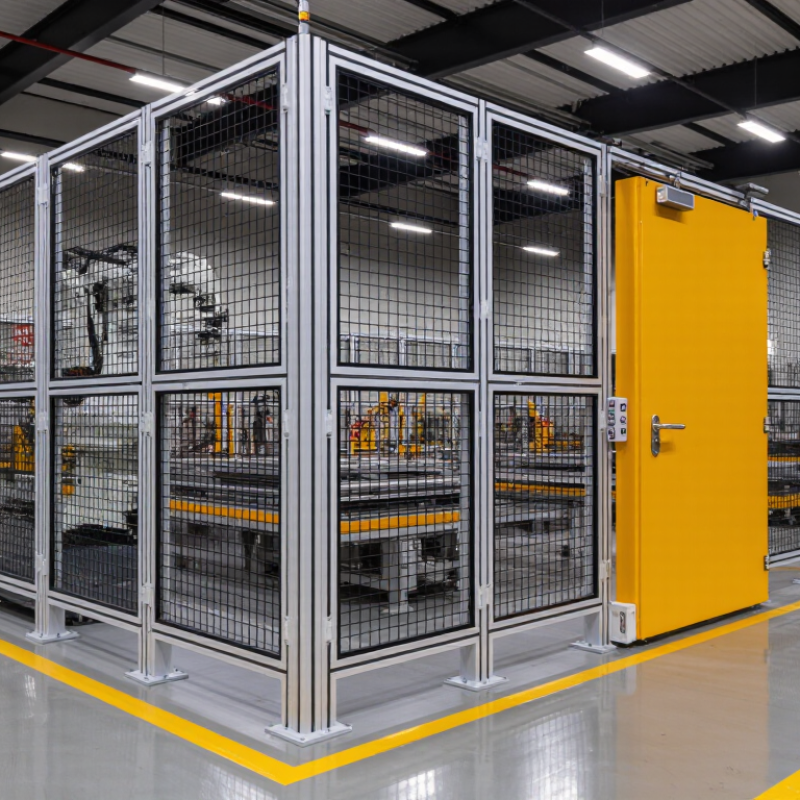
How to Choose the Right Robo Safety Fence?

Define the Safety Risks and Protection Goals of the Robot Cell

How to Choose the Right Robo Safety Fence?

Define the Safety Risks and Protection Goals of the Robot Cell

A suitable safety fence begins with a clear risk assessment, not a catalog image. Observe the robot’s full movement, including tool rotation, payload swing, and unexpected restart. Mark crush points, shear zones, pinch areas, and locations where parts could be ejected. Consider normal production, setup, cleaning, maintenance, and fault recovery. Each activity may create a different exposure.

Your protection goal should be specific and measurable. It may involve preventing people from entering the cell, containing broken tooling, or maintaining a safe distance from moving equipment. Check visibility, gate access, emergency stopping, and reset controls. Interlocks should prevent hazardous motion when the gate opens. They should not be treated as the only safeguard. I have seen teams focus on fence height while ignoring gaps beneath conveyors. That assumption is often wrong. Test the cell with realistic tools, materials, and operator movements.

Tips: Walk the cell with operators and maintenance staff. Use a simple layout drawing to mark every access point. Measure reach distances and clearance gaps. Review foreseeable misuse, not only intended operation. Validate safeguards after installation, then repeat checks when tooling or software changes. Document decisions, test results, and unresolved concerns. Small oversights matter.

Check Robot Fence Standards, Materials, and Structural Requirements

Choosing a robot safety fence starts with standards, not appearance. Check ISO 10218 for robot safety requirements and ISO 14120 for guard design. ISO 13857 helps determine safe distances from hazardous movements. Regional rules may add stricter details, so confirm requirements with a qualified safety professional.

Material selection depends on the work area. Welded steel panels suit heavy industrial cells and resist impact. Mesh panels improve visibility and airflow, but openings must prevent hand or finger access. Polycarbonate can support clear viewing near automated equipment, although heat, chemicals, and scratches may reduce its service life. Stainless steel is useful in corrosive or hygienic environments. Cheap material often becomes expensive after repairs.

The structure must remain stable during normal operation and foreseeable contact. Anchor posts to a suitable floor, and check the slab before drilling. Doors should use monitored interlocks, with access points positioned away from robot reach. Leave enough space for maintenance without creating hidden gaps. A safety distance measured only from the fence may be wrong; measure from the nearest reachable hazard. During inspections, small issues often appear first: loose bolts, damaged mesh, or doors that do not close fully. No design is perfect forever. Recheck the enclosure after robot changes, tooling upgrades, or repeated impacts.

Choose the Right Fence Layout, Height, and Access Points

Choosing the right robo safety fence starts with the layout, not the mesh panel. The International Federation of Robotics reported 4.28 million industrial robots operating worldwide in 2023. More robots mean more movement, reach, and maintenance traffic around cells. Map the robot envelope, tooling swing, conveyors, and emergency exits before fixing the fence line. Leave room. A narrow aisle may save floor space, but it can obstruct inspection and evacuation.

Fence height should match the hazard, not a convenient standard size. ISO 13857 provides safety distances for preventing access to dangerous zones, while ISO 14120 addresses the design and construction of guards. Measure the robot’s maximum reach, including payload and unexpected stopping positions. A taller fence is not automatically safer. Gaps, climbable surfaces, and objects left beside the barrier can defeat it. This is where a drawing can mislead.

Access points deserve the same engineering attention as the fence itself. Place gates where operators naturally approach, not where installation seems easiest. Use guarded doors, monitored interlocks, and clear visibility into the cell. The U.S. Bureau of Labor Statistics recorded 5,283 fatal work injuries in 2023, showing why access control cannot be treated as a minor detail. Avoid excessive gates; each one adds inspection and maintenance demands. I would also challenge my own layout after a trial run. Real operators do not always follow the planned path. That matters.

Integrate Doors, Interlocks, Sensors, and Emergency Controls

Choosing the right robo safety fence begins with the complete access system, not the mesh alone. A strong fence controls reach, movement, and unexpected entry around the robot cell. During a site review, mark loading points, maintenance routes, and operator positions. Door locations should support normal work without encouraging shortcuts. Small details matter.

Each access door needs a suitable interlock connected to the machine’s safety control circuit. Opening the door should create a controlled stop before hazardous motion continues. An interlock is not a magic lock. It requires correct installation, testing, and protection from tampering. Add sensors where a person could remain inside the guarded area after entry. Their position should detect real human access, not only a moving object. Emergency stop controls must remain visible and reachable from expected working positions. They should not replace the fence or interlock.

A practical commissioning test should include every door, sensor, reset button, and emergency control. Open a door during operation. Block a sensor. Break the safety circuit. Check whether the robot stops as intended and whether reset requires a deliberate action. Keep test records and repeat them during maintenance. I have seen well-built cells weakened by poor reset logic and rushed inspections. That assumption deserves challenge. Review the risk assessment whenever tooling, software, or production flow changes. Local safety requirements should guide the final design.

How to Choose the Right Robo Safety Fence? - Integrate Doors, Interlocks, Sensors, and Emergency Controls

A practical selection guide for robotic cells, automated machinery, and restricted-access production areas

Application or Risk Profile Typical Fence Configuration Recommended Access Door Interlock and Locking Approach Sensor Integration Emergency Control Arrangement Key Selection Considerations
Small robotic pick-and-place cell Welded mesh or framed panel system
Typical height: 1,400–2,000 mm
Single hinged personnel door
Clear opening commonly around 700–1,000 mm
Guard-door interlock switch with positive monitoring
Guard locking may be unnecessary when stopping time is shorter than access time
Door-position switch Reset pushbutton Optional presence sensor Emergency-stop button outside the cell and an additional reachable control inside where personnel may become trapped Confirm robot stopping time, minimum separation distance, visibility of the work area, and safe restart conditions
High-speed robot with hazardous residual motion Rigid mesh or solid-panel guarding
Typical height: 1,800–2,200 mm
Hinged or sliding door designed for frequent operator access Guard-locking interlock that keeps the door locked until hazardous motion has stopped
Use monitored dual-channel safety circuits where required by the risk assessment
Coded interlock Safe speed or standstill monitoring Safety relay or safety PLC Emergency-stop devices at operator stations, loading points, and other accessible locations The locking release time should be based on measured or validated stopping performance, not on a general preset value
Palletizing or depalletizing system Heavy-duty framed mesh panels with protected transfer openings
Typical height: 1,800–2,500 mm
Sliding maintenance gate plus material-transfer openings designed to prevent reach-through access Interlocked access gates with controlled restart after every gate opening
Transfer openings should not permit access to hazardous zones
Safety light curtains Area scanners Gate switches Emergency-stop buttons at pallet infeed, pallet outfeed, operator controls, and maintenance access points Check pallet dimensions, robot reach, conveyor openings, forklift traffic, and the reset location relative to the guarded area
Collaborative robot with occasional manual loading Partial guarding, fixed barriers, or perimeter protection where the risk assessment identifies residual hazards Manual access door or removable access panel with controlled entry Interlock selection depends on the task, robot mode, tool hazard, and whether hazardous motion remains during collaborative operation Presence sensing Mode selector Speed and separation monitoring Clearly visible emergency-stop devices located at the operator position and near foreseeable points of access Collaborative operation does not eliminate the need to assess sharp tools, pinch points, payloads, fixtures, and unexpected restart
Welding, cutting, grinding, or spraying cell Rigid panels with suitable protection against sparks, radiation, dust, or process ejection
Solid panels may be needed for localized hazards
Hinged maintenance door with limited routine access
Use dedicated loading doors when possible
Guard locking or trapped-key arrangement may be appropriate for stored energy, fumes, heat, or delayed hazards Door interlocks Process enclosure switches Ventilation monitoring Emergency stops should interrupt the hazardous process and place connected equipment in a defined safe state Evaluate heat, arc flash, laser or optical radiation, fumes, noise, combustible dust, and stored pneumatic or hydraulic energy
Large multi-robot production line Modular perimeter fencing with multiple controlled access points
Typical height: 1,800–2,500 mm
Multiple hinged or sliding gates, each individually identified and monitored Safety PLC architecture with monitored interlocks, controlled reset, and zone-based access where justified Interlock switches Safety scanners Light curtains Zone sensors Emergency stops distributed by zone, with clear labeling and visibility from normal operating positions Define safe zones, prevent bypassing, document reset logic, and verify that stopping one zone cannot create a new hazard in another
Maintenance and tool-change access Fixed panels with a dedicated service gate and sufficient working clearance Lockable hinged door or controlled maintenance access gate Guard locking, personal lockout provisions, or trapped-key systems may be required where energy isolation is necessary Access switch Isolation status Safe-state feedback Emergency-stop controls should remain accessible during maintenance, but they should not replace energy isolation procedures Provide sufficient space for inspection, cleaning, lubrication, calibration, and removal of tooling without defeating the guard
Forklift or pallet-truck interface Impact-resistant posts, reinforced mesh, and protected corners near traffic routes Vehicle access gate with controlled opening and pedestrian access gate separated where practical Interlock the vehicle gate with robot motion and conveyor controls
Consider traffic lights, warning signals, and access authorization
Gate switches Vehicle detection Warning beacons Emergency-stop devices should be reachable from both pedestrian and vehicle operating positions Consider impact loads, floor anchoring, turning radius, visibility, pedestrian segregation, and safe access during material handling

Design basis: Use the table as a preliminary selection guide only. Final fence dimensions, opening sizes, interlock type, sensor performance, emergency-stop layout, and safety control architecture should be validated through a documented machine risk assessment and applicable requirements, including ISO 12100, ISO 14120, ISO 14119, ISO 13850, ISO 13849-1, and IEC 60204-1 where applicable.

Verify Installation, Testing, Maintenance, and Future Expandability

How to Choose the Right Robo Safety Fence?

Industrial robot cells are expanding quickly. The International Federation of Robotics reported 541,302 industrial robots installed worldwide in 2023. A suitable safety fence must therefore support both present risks and future production changes. Begin with a documented risk assessment under ISO 12100. Verify fence height, openings, reach distances, and access points against ISO 13857. Gates should use monitored interlocks, and emergency stopping functions must be tested under realistic operating conditions. A visual inspection is not enough.

Installation Quality

Installation quality matters. Check anchor bolts, panel alignment, sharp edges, electrical bonding, and clear separation from moving equipment. Confirm that bypassing an access gate cannot restart the robot cell. Validation should follow the safety-control requirements of ISO 13849-2, with test results, measured stopping times, and sign-off records retained. Small details matter. A poorly positioned gate can create a hidden reach-through gap.

Maintenance and Expansion

Maintenance should include scheduled inspections of hinges, locks, mesh panels, cables, sensors, and warning signs. Record every repair and retest after software, tooling, or layout changes. OSHA’s enforcement data consistently lists machine guarding among frequently cited workplace safety issues, showing why routine verification cannot become paperwork only. For expansion, reserve floor space, spare mounting points, accessible cable routes, and safety-control capacity. Modular panels can reduce disruption. Still, future compatibility is never automatic. A larger robot, new gripper, or altered path may invalidate the original assessment. I would not trust a perfect checklist after an imperfect modification.

Contact us

Let us help you with the right solution

Address

HQ
Industrivej 10
5550 Langeskov

Talk to a consultant

Write to us to get in touch with a consultant

Address

HQ
Industrivej 10
5550 Langeskov

Thank you for your inquiry

Be contacted

Questions? Write to us and get a response

Address

HQ
Industrivej 10
5550 Langeskov

Thank you for your inquiry